

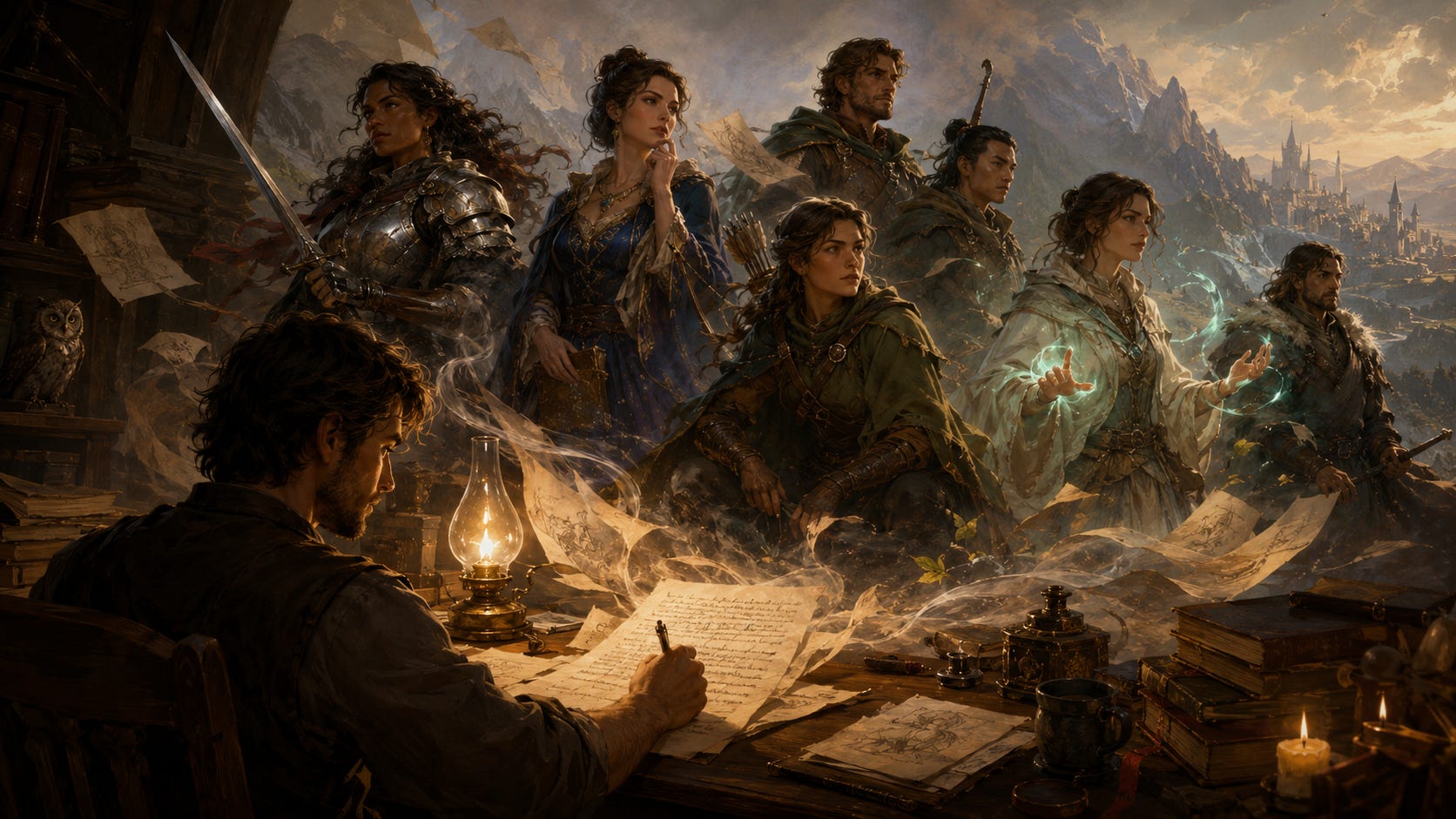
An author friend of mine recently said he’s working on a story where the hero is a woman. He hopes to get her right. There’s always debate online on whether a man can write decent female characters and vice versa.
The answer to getting it right, at least in my experience, is far less complicated than people often make it sound. Just write them as people.
That does not mean pretending men and women are identical nor completely different to each other. It means giving female characters the same care, depth, flaws, ambitions, fears and contradictions that you would give any male character. They should not exist simply to fill a role, deliver a message or demonstrate how progressive the author is. They should exist because they belong in the story.
When I write a female character, I do not begin by asking myself how a woman would behave in every possible situation. I ask how a person would react because funnily enough we’re all human, men and women.

We All Know Women
Male authors are sometimes told (often by female authors) that they cannot properly understand or write women. Yet almost every man has women in his life.
We have mothers, sisters, daughters, wives, partners, friends, colleagues, teachers and countless others who have influenced us. We have seen their strengths, weaknesses, habits, tempers, insecurities, loyalties and ambitions.
Those traits provide a vast amount of material. It means observing the people around you in the same way writers observe everything else. A character might inherit one person’s stubbornness, another’s dry humour and someone else’s ability to remain calm when everyone around them is panicking.
That is how characters are created. They are built from fragments of real human behaviour. The mistake comes when writers stop observing people and start writing stereotypes or put them on some pedastal to push some BS progressive agenda.
Stop writing “Strong female characters” just write “female characters”
The phrase “strong female character” has become almost meaningless and the butt of countless ridicule.
Strength in this sense is too often confused with aggression, arrogance or physical dominance effectively removing feminity and replacing it with all the worst aspects of manhood. A supposedly strong woman is written as someone who is always right (arrogant), never afraid (bravado), better than every man in the room and permanently ready with a smug riposte or smart ass remark.
The modern “girl boss” archetype is often deeply unlikeable because she is not belivable and not allowed to possess meaningful flaws. Yes ladies I said it. You too have flaws and weaknesses.
She does not learn because the story already treats her as perfect. She does not need anyone because dependence, loyalty and cooperation are bitterly treated as weaknesses. The male characters around her are frequently made incompetent so that she can appear impressive without earning it. Readers notice this.
A genuinely strong character both male and female can fail. She can doubt herself. She can make the wrong decision, lose her temper or trust the wrong person. She can be frightened and still act. She can ask for help from men without becoming helpless.
Do Not Replace One Stereotype With Another
For decades, some female characters were written as little more than love interests, victims or prizes for the hero. Correcting that was necessary, but the solution was not to swing towards a different kind of shallow character.
A woman does not have to be meek and useless.
She also does not have to be an invincible warrior who humiliates every man she meets.
Both are stereotypes.
In The Sundered Crown Saga, I have written women who fight, lead, advise, endure and support. They contribute directly to the success of the heroes, but they are not flawless. They have their own motivations and personal struggles. They can be brave without being fearless and compassionate without being weak.
They are not Mary Sues who master every challenge without effort. Nor are they passive figures waiting for male characters to save them.
They are part of the world, the conflict and the story.
That balance matters.
Men and Women Have Different Strengths
There is a strange tendency in modern storytelling to suggest that equality requires pretending there are no meaningful differences between men and women.
I do not believe that creates better characters.
Men and women can possess different physical, emotional and social strengths. Individuals vary enormously, of course, but acknowledging differences does not diminish either sex. It creates opportunities for characters to complement one another.
A woman does not need to become indistinguishable from a man to be worthy of respect. She does not need to prove her strength by rejecting every traditionally feminine quality. Compassion, diplomacy, patience, emotional intelligence and the ability to hold people together are not lesser traits.
Nor should male strength, courage, protectiveness or physical ability automatically be portrayed as crude or dangerous.
The best groups of heroes work because the characters bring different abilities to the struggle. One person sees what another misses. One has the courage to act while another has the wisdom to hesitate. One can win a battle while another prevents the battle from happening at all.
Nobody succeeds entirely alone.
Cooperation Is More Interesting Than Humiliation
One of the most tiresome features of some modern stories is the belief that a female character can only be elevated by tearing male characters down.
The men become fools, cowards or villains so that the woman can appear competent.
This does not create equality. It creates resentment and weakens the entire cast.
Strong characters should challenge one another, disagree and occasionally fail each other. However, there should also be mutual respect. Men and women should be able to recognise each other’s strengths and compensate for each other’s weaknesses.
That is how people overcome serious challenges in real life, and it is how compelling groups of heroes succeed in fiction.
In my own books, male and female characters aid one another. They fight together, advise one another, protect each other and sometimes save each other. Their success depends on cooperation rather than one sex proving itself superior to the other.
That does not mean every relationship must be harmonious. Conflict is necessary. Some characters will dislike each other, distrust each other or compete for authority. The important thing is that the conflict grows naturally from personality and circumstance rather than from the author’s desire to lecture the audience.
Give Women Real Flaws
A character without flaws is not admirable. They are boring.
Female characters should be allowed to be selfish, stubborn, jealous, reckless, proud or mistaken. They should make choices that have consequences. They should sometimes be responsible for making a situation worse.
Too many writers are afraid that giving a woman negative qualities will make the character unlikeable. Yet male characters have always been permitted to be difficult, damaged and morally complicated.
Women should be granted the same freedom.
A flawed character can still be brave. A selfish character can still perform a selfless act. Someone who makes a terrible mistake can still earn redemption.
Readers connect with growth, not perfection.
Femininity Is Not a Weakness
Another mistake is assuming that the only way to create a powerful female character is to strip away everything feminine about her.
She must hate dresses, mock romance, reject motherhood, despise domestic life and prove that she is superior to women who make different choices.
This is not empowerment. It is simply another way of treating femininity with contempt.
A woman can be nurturing and formidable. She can want a family and still possess ambition. She can enjoy beauty, love and comfort while also being willing to fight when necessary.
Likewise, a female warrior does not need to behave like a stereotypical man. She can be physically dangerous while retaining a distinctly feminine identity.
There is no single correct way for a woman to be strong.
Respect the Character and the Reader
The most important element is respect.
Respect your female characters enough to give them genuine personalities rather than turning them into symbols. Respect male characters enough not to reduce them to obstacles or punchlines. Respect readers enough to let them interpret the story without constantly explaining who they should admire.
Readers can recognise sincerity.
They know when a character has been created because the author genuinely cares about them. They also know when a character exists primarily to satisfy a trend, make a political point or lecture the audience.
The goal should not be to create a perfect female character. It should be to create a believable one.
Write People, Not Talking Points
When I write women, I use the same principles I use when writing men.
I ask what they want.
I ask what they fear.
I consider what they are good at, where they struggle and how they behave when placed under pressure. I think about the women I have known and the traits that made them memorable. Then I shape those observations into someone new.
The result should be a character who feels like part of the story rather than an argument inserted into it.
Strong female characters do not need to dominate men, reject femininity or win every fight. They need agency, personality and purpose.
They should be allowed to fight hard, support others, make mistakes and require help. They should be capable without being perfect and vulnerable without being useless.
Above all, male and female characters should be allowed to need each other.
That is not weakness. It is humanity.
Respect both sexes, recognise their strengths and weaknesses, and show how they can achieve more together than they ever could alone.
Do that, and the characters will resonate with readers.

My serial fantasy character will struggle and fail. In a recent post she was fighting back-to-back with her husband. They were defeated and he was killed. In her grief and rage she gave an order that was objectively evil.
This is all good advice. I love writing female characters. I think my readers favourites are the females too. I’m currently working on a sequel to my popular vampire novel ‘Ofelia’. It’s interesting because it completely subverts the usual sequel structure. It also exposes a vulnerability in her - hubris, which almost costs her everything.